
Web Content Display (Global)
Northern Territory Certificate of Education and Training — NTCET
On this page
What is the NTCET?
The Northern Territory Certificate of Education and Training (NTCET) recognises the knowledge and skills students gain through formal study. It is a modern, internationally recognised senior secondary qualification that prepares students with the capabilities they need for further education, training, and employment.
The completion requirements, approved by the Minister for Education and Training, make the NTCET a unique and contemporary certificate that is closely aligned with senior secondary directions in other states.
The NTCET provides students with access to flexible learning arrangements where students have increased opportunities to develop the business, interpersonal and employment-related skills needed for the future.
NTCET requirements
Students must achieve a minimum of 200 credits to complete the NTCET. These credits comprise of compulsory requirements (awarded a total of 100 credits) and non-compulsory requirements (awarded a total of 100 credits).
Students receive a grade for each subject (A to an E for Stage 1 subjects and A+ to E- for Stage 2 subjects). For the compulsory subjects, a C grade or higher will be required to complete the NTCET at Stage 1 and a C- grade or higher for Stage 2.
At Stage 1, all work is school assessed. At Stage 2, 30 percent of work in each subject (such as examinations, performances and major investigation assignments) is marked by SACE Board appointed markers. The rest of the work is school assessed, with awarded grades moderated by the SACE Board appointed moderators.
On completion of the NTCET, a certificate of completion is provided. A record of achievement related to a student’s achievement is available online via Students Online for both Stage 1 and Stage 2 subject results.
Compulsory Requirements
To be eligible to receive the NTCET, students must achieve a ‘satisfactory achievement’ for the following compulsory subjects:
- Literacy – at least 20 credits from a range of English subjects
- Numeracy – at least 10 credits from a range of mathematics subjects
- Exploring Identities and Futures – 10 credits at Stage 1.
- SACE subjects and/or courses that the SACE Board recognises – at least 60 credits at Stage 2.
Note: ‘Satisfactory achievement’ is defined as a C grade or higher at Stage 1, a C- grade or higher at Stage 2, ‘granted’ for recognised learning, and ‘completed’ for modified subjects.
Non-compulsory Requirements
The remaining 100 credits can be achieved through additional SACE subjects, Vocational Education and Training (VET) courses and/or recognised learning gained at Stage 1 or Stage 2. Where SACE subjects are used to complete this requirement, a minimum 40 credits must be at satisfactory achievement.
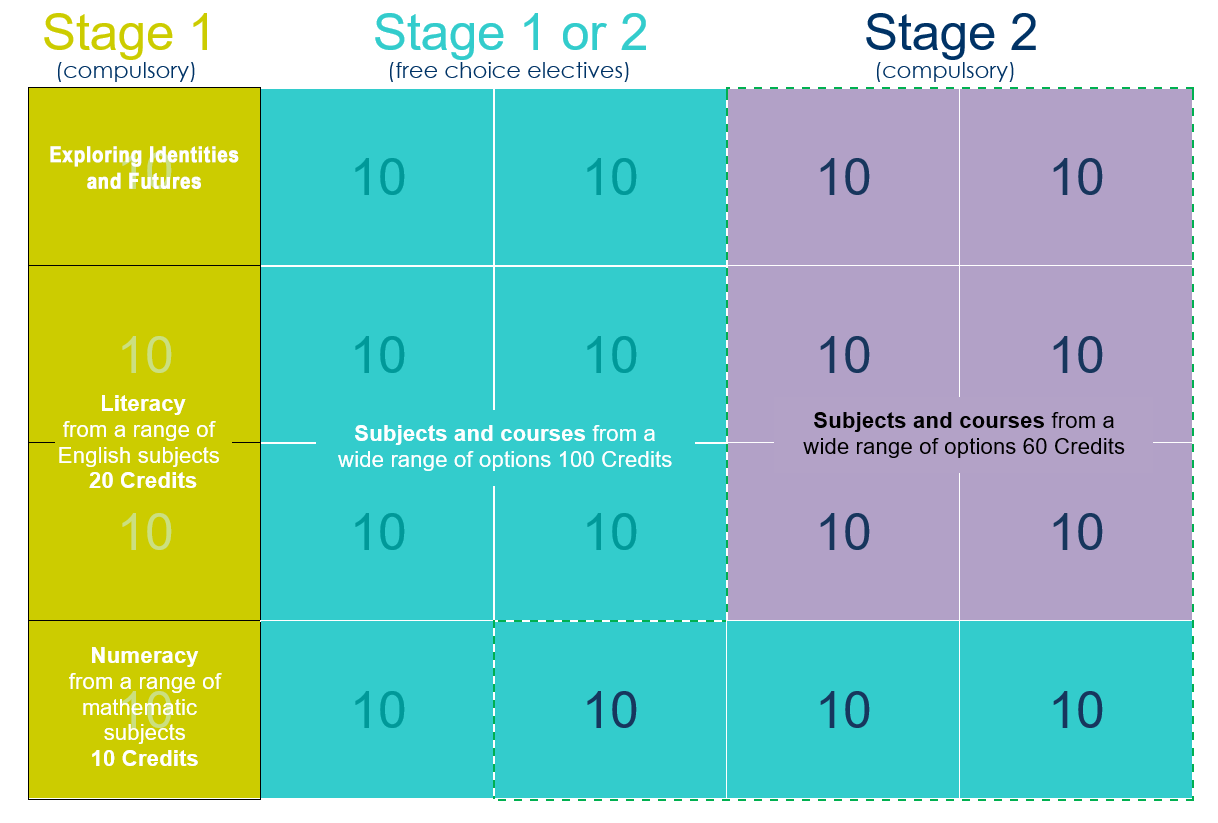
- In order to gain an Australian Tertiary Admission Rank (ATAR), students are required to successfully complete 90 credits of Stage 2 Tertiary Admissions Subjects (TAS) as indicated by the dotted line on the above NTCET pattern diagram.
- Refer to the SACE Board VET Recognition Register for information about the recognition of VET in the NTCET.
- Interstate and overseas students may be granted status for studies. Students who have completed a full Australian or overseas senior secondary program or part qualification that is considered to be the equivalent of NTCET Stage 1 will be granted status, including Exploring Identities and Futures. These students will need to show that they have met the literacy and numeracy requirements.
- Flexible Options, including recognised studies, can contribute 30 credits to the university aggregate. For more information see the current tertiary entrance booklet on SATAC publications.
- Students with disabilities that affect intellectual or adaptive abilities can choose from modified subjects that are designed to allow them to demonstrate their learning in a range of challenging and achievable learning experiences. All modified subjects focus on students developing their personal learning goals and capabilities for social living and work.
Resources
For resources relating to the NTCET, refer to the below links:
- Teaching Stage 1 and Stage 2 NTCET subjects
- Stage 2 assessment groups and combining small classes
- Get a copy of past results
- Students Online
Other documents
- Tertiary Entrance Statement information sheet [PDF 981KB]
- NTCET results information sheet [PDF 1.2MB]
- NTCET pattern [PDF 427KB]
Subject lists
A list of subjects available in the NTCET.
- SACE subjects and codes 2026 [DOC 722KB]
- Subject search for teachers - South Australian Certificate of Education
- Stage 1 NTCET Subjects Poster [PDF 290KB]
- Stage 2 NTCET Subjects Poster [PDF 343KB]
Statistics
The Northern Territory Board of Studies (NTBOS) provides statistics on the NTCET.
Policies and Guidelines
Policies and guidelines can be found on the eLearn Policy and advisory library.
Calendar
All key dates for the NTCET can be found on the Northern Territory calendar.
Contacts
General enquiries
+61 8 8944 9253
NTCET student enquiries line
1800 009 282
Email
NTcertification.DET@education.nt.gov.au